
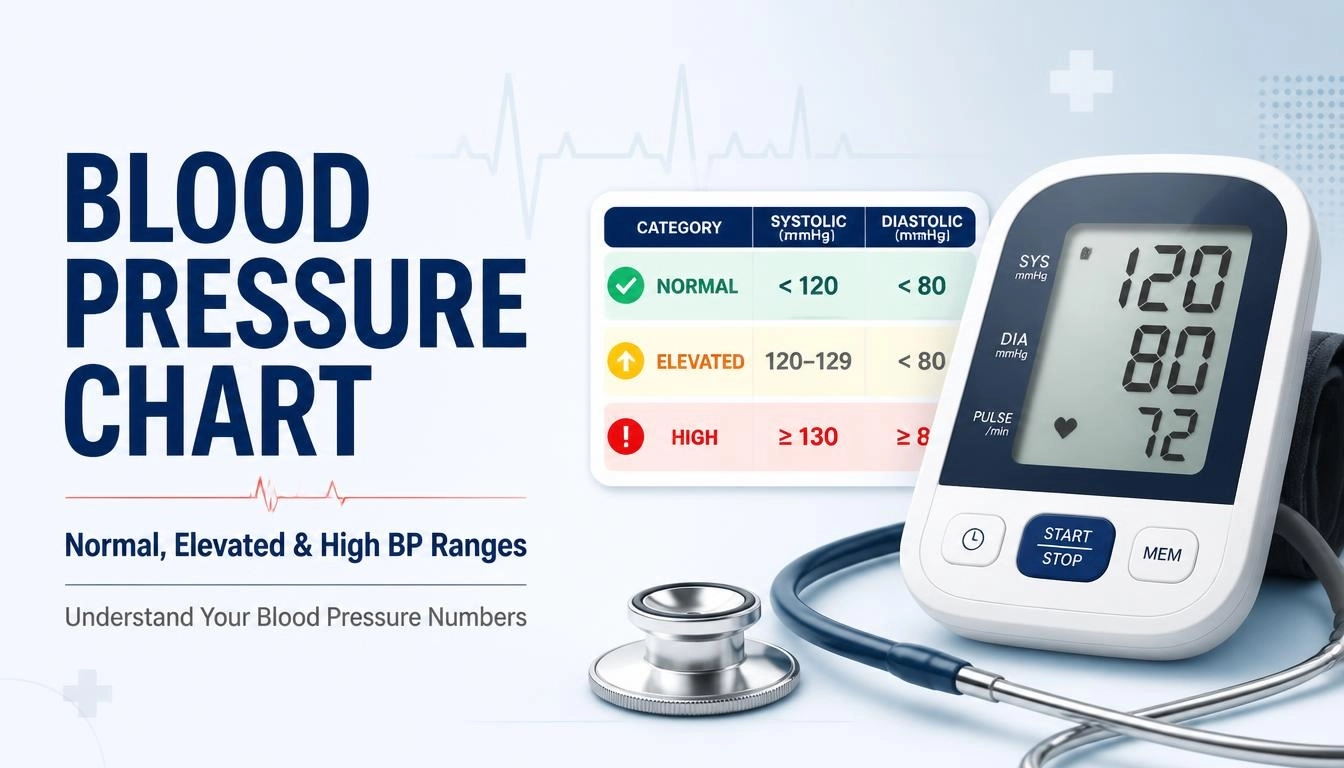
Blood Pressure Chart: Normal, Low and High BP Ranges
A blood pressure chart helps you understand whether your blood pressure is normal, elevated or high. For most adults, a normal reading is below 120/80 mm Hg. Readings of 130/80 mm Hg or higher fall into the high blood pressure categories, depending on the numbers. Use the chart below to identify your reading and understand what to do next.
Blood Pressure Chart for Adults
The following blood pressure chart shows the four standard adult categories based on American Heart Association (AHA) and American College of Cardiology (ACC) guidelines, also presented by Mayo Clinic.
| Blood Pressure Category | Systolic (Top Number) | And/Or | Diastolic (Bottom Number) | What to Do |
|---|---|---|---|---|
| Normal | Below 120 | AND | Below 80 | Maintain a healthy lifestyle. |
| Elevated | 120–129 | AND | Below 80 | Adopt heart-healthy habits and monitor your BP. |
| Stage 1 Hypertension | 130–139 | OR | 80–89 | Discuss lifestyle changes and possible medication with a healthcare professional. |
| Stage 2 Hypertension | 140 or higher | OR | 90 or higher | Seek medical evaluation; medication may be needed. |
Important: If your top and bottom numbers fall into different categories, use the higher category. For example, 125/85 mm Hg is classified as Stage 1 hypertension because the diastolic number is 85.
A diagnosis is not made from one reading alone. Healthcare professionals generally use the average of multiple properly taken measurements.
Blood Pressure Emergency: When Is It Dangerous?
A reading higher than 180 systolic and/or 120 diastolic mm Hg is considered severely high.
- Wait at least one minute and measure again.
- If the reading remains this high, contact a healthcare professional immediately.
- If you also experience chest pain, shortness of breath, weakness, numbness, vision changes or difficulty speaking, call emergency services immediately.
Do not wait for symptoms to improve on their own.
What Is Normal Blood Pressure?
For most adults, normal blood pressure is below 120/80 mm Hg.
The first number (systolic) should be below 120, and the second number (diastolic) should be below 80.
Blood pressure can change throughout the day due to activity, stress, caffeine, sleep and other factors. Therefore, repeated measurements are more useful than relying on a single result.
If your readings remain within the normal range, continue maintaining healthy habits and follow your healthcare professional’s recommendations.
What Do the Two Blood Pressure Numbers Mean?
A blood pressure reading is written as two numbers separated by a slash. For example, 120/80 mm Hg.
Each number measures pressure in your arteries at a different point in the heartbeat.
Systolic Blood Pressure (Top Number)
Systolic blood pressure is the first or upper number. It measures the pressure against your artery walls when your heart contracts and pumps blood.
For example, in a reading of 120/80, the systolic pressure is 120 mm Hg.
A consistently elevated systolic number can indicate increased cardiovascular risk.
Diastolic Blood Pressure (Bottom Number)
Diastolic blood pressure is the second or lower number. It measures the pressure in your arteries while your heart relaxes between beats.
In a reading of 120/80, the diastolic pressure is 80 mm Hg.
A high diastolic number can also indicate hypertension, even when the systolic number is below 130.
Both numbers matter when evaluating your blood pressure.
Blood Pressure Ranges Explained
Understanding each category helps you recognize when a reading needs attention.
1. Normal Blood Pressure: Below 120/80
A reading below 120 systolic AND below 80 diastolic is considered normal for adults.
Examples:
- 110/70
- 115/75
- 118/78
These readings fall within the normal category. Continue regular physical activity, balanced eating and routine health checks.
2. Elevated Blood Pressure: 120–129 and Below 80
Elevated blood pressure occurs when the systolic number is between 120 and 129 while the diastolic number remains below 80.
Examples:
- 120/70
- 125/75
- 128/78
This category is not yet classified as hypertension. However, it indicates that your blood pressure is above the normal range. Lifestyle changes and regular monitoring can help prevent further increases.
3. Stage 1 Hypertension: 130–139 or 80–89
Stage 1 hypertension is identified when the systolic number is 130–139 OR the diastolic number is 80–89.
Examples:
- 130/80
- 135/85
- 125/85
Even if only one number reaches this range, the reading falls into Stage 1 hypertension.
A healthcare professional can assess your overall cardiovascular risk and recommend lifestyle changes or medication when appropriate.
4. Stage 2 Hypertension: 140 or Higher or 90 or Higher
Stage 2 hypertension occurs when the systolic number reaches 140 or higher OR the diastolic number reaches 90 or higher.
Examples:
- 140/90
- 150/95
- 160/100
This category requires medical evaluation. Treatment commonly includes lifestyle changes and may involve one or more medications.
Blood Pressure Chart by Age
Blood pressure can change as people get older, but there is no single adult chart that assigns a different normal range to every age.
For most adults, the standard categories remain the same:
- Normal: Below 120/80 mm Hg
- Elevated: 120–129 systolic and below 80 diastolic
- Stage 1 hypertension: 130–139 systolic or 80–89 diastolic
- Stage 2 hypertension: 140 or higher systolic or 90 or higher diastolic
Systolic pressure often increases with age as arteries become less flexible. However, high readings should not automatically be considered normal because someone is older.
Children and teenagers have different reference ranges based on age, sex and height. Their readings should be evaluated using pediatric guidelines.
How to Read Blood Pressure Measurements
To understand a reading, look at both numbers and identify which category each one falls into.
Here are some common examples:
| Blood Pressure Reading | Category |
|---|---|
| 110/70 | Normal |
| 120/70 | Elevated |
| 124/80 | Stage 1 Hypertension |
| 128/83 | Stage 1 Hypertension |
| 130/80 | Stage 1 Hypertension |
| 132/80 | Stage 1 Hypertension |
| 135/85 | Stage 1 Hypertension |
| 140/90 | Stage 2 Hypertension |
Why is 124/80 Stage 1?
Although the systolic number is below 130, the diastolic number is 80. Since either number can determine the category, the reading falls into Stage 1 hypertension.
These examples describe adult blood pressure categories, not individual diagnoses.
How to Measure Blood Pressure Correctly at Home
Accurate measurements help you and your healthcare professional understand your blood pressure over time.
Follow these steps:
- Avoid smoking, caffeine, alcohol and exercise for at least 30 minutes before measuring.
- Empty your bladder before the measurement.
- Sit quietly for at least five minutes.
- Keep your back supported and feet flat on the floor.
- Do not cross your legs.
- Place the cuff on your bare upper arm, not over clothing.
- Keep your arm supported at heart level.
- Do not talk or move during the measurement.
- Take two readings, one minute apart.
- Record both results and share them with your healthcare professional.
Use a validated automatic upper-arm monitor with the correct cuff size. Taking measurements at the same time each day can make your records easier to compare.
What Causes High Blood Pressure?
High blood pressure, also known as hypertension, develops when blood consistently pushes against artery walls with excessive force.
Common risk factors include:
- Eating too much sodium.
- Physical inactivity.
- Excess body weight.
- Smoking.
- Excessive alcohol consumption.
- Family history of hypertension.
- Increasing age.
- Kidney disease and certain other medical conditions.
High blood pressure often has no noticeable symptoms. Regular measurement is the most reliable way to identify it.
How to Maintain Healthy Blood Pressure
Lifestyle changes can help maintain healthy readings and support the management of hypertension.
- Reduce salt: Limit high-sodium processed foods and excessive added salt.
- Eat a balanced diet: Include vegetables, fruits, whole grains and other nutrient-rich foods.
- Exercise regularly: Aim for at least 150 minutes of moderate physical activity per week if appropriate for your health.
- Maintain a healthy weight: Gradual weight management can help reduce blood pressure.
- Avoid smoking: Smoking increases cardiovascular risk and damages blood vessels.
- Limit alcohol: Excessive alcohol consumption can raise blood pressure.
- Follow medical advice: Take prescribed medication as directed and do not change your treatment without consulting your healthcare professional.
Frequently Asked Questions
For most adults, a normal reading is below 120/80 mm Hg. Both the systolic number and diastolic number must be below their respective limits.
Yes. Under the AHA and ACC classification, 130/80 mm Hg falls into Stage 1 hypertension. Repeated measurements and medical evaluation are needed to confirm a diagnosis.
The bottom number is diastolic blood pressure. It measures the pressure in your arteries while your heart relaxes between beats.
A reading of 120/70 mm Hg falls into the elevated category because the systolic number is 120. It is not classified as hypertension.
Systolic blood pressure often increases with age as arteries become less flexible. However, consistently high readings should be evaluated rather than dismissed as a normal part of aging.
Conclusion
Understanding your blood pressure helps you recognize whether your readings are normal, elevated or high. The blood pressure chart provides a simple way to compare your systolic and diastolic numbers and identify the appropriate category.
For most adults, a reading below 120/80 mm Hg is normal. If your numbers repeatedly reach 130/80 mm Hg or higher, discuss them with a healthcare professional. Regular monitoring, healthy lifestyle choices and appropriate medical care can help protect your heart and reduce the risk of complications.