
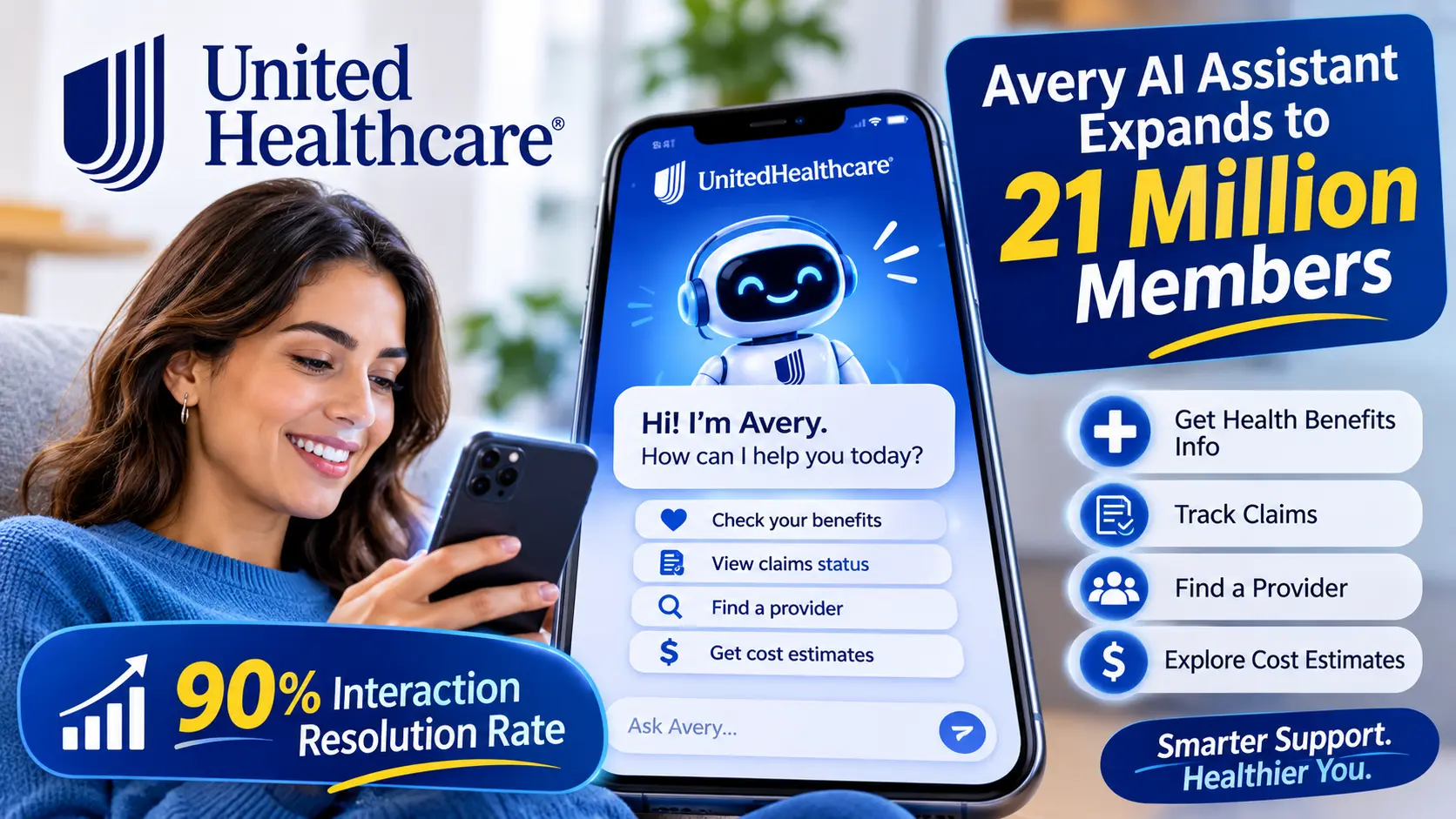
UnitedHealthcare Expands Avery AI Assistant to 21 Million Members
UnitedHealthcare is expanding its generative AI assistant, Avery, to 21 million eligible members across its commercial, Medicare and Medicaid health plans. The expansion marks a major step in the insurer’s effort to use artificial intelligence to make health plan information and care navigation easier to access.
Avery helps members find information about insurance benefits, claims, provider networks, medical costs and plan balances. UnitedHealthcare says the assistant resolved 90% of member interactions during its rollout, with the remaining 10% transferred to human advocates. However, the company has not published the detailed methodology behind that resolution figure.
The expansion highlights how health insurers are using AI to handle routine administrative questions while keeping human support available for issues that need additional attention.
What Is UnitedHealthcare’s Avery AI Assistant?
Avery is a generative AI companion developed by UnitedHealthcare, part of UnitedHealth Group. Members who are eligible to use the service can access it through the UnitedHealthcare mobile app or myuhc.com.
The assistant provides responses based on a member’s personal health plan information. It brings together details from benefits, provider and claims systems so users can ask questions in natural language rather than searching across multiple pages or tools.
UnitedHealthcare introduced Avery in March 2026. At launch, the tool was available to approximately 6.5 million members with employer-sponsored health plans and 160,000 Medicare Advantage members. The company initially planned to expand access to 20.5 million members by the end of the year.
Avery Expands Access to 21 Million Eligible Members
UnitedHealthcare expanded Avery’s availability to 21 million members in October 2026, according to the company update reported by Artificial Intelligence News. This is higher than the original target of 20.5 million members by the end of the year.
The 21 million figure represents people who are eligible to access Avery. It does not mean that 21 million members actively use the assistant. UnitedHealthcare has not disclosed the number of active users or the total number of conversations handled by the system.
The distinction matters when evaluating adoption. Expanding access shows that the company has made the tool available to a larger group, while active usage data would show how many members choose to use it.
UnitedHealthcare Reports a 90% Resolution Rate
UnitedHealthcare says Avery resolved 90% of member interactions during its initial rollout. The remaining 10% were transferred to human advocates for additional assistance, according to comments from the company’s chief data and analytics officer, Craig Kurtzweil, reported by Fierce Healthcare.
The insurer has not disclosed the methodology used to calculate the 90% figure. It has also not released a detailed breakdown showing how resolution rates vary by question type, member group or complexity.
For that reason, the figure should be understood as a company-reported performance measure rather than an independently verified result. It provides an indication of how UnitedHealthcare describes Avery’s early performance, but it does not establish that the assistant can resolve every type of health insurance issue.
What Can Members Do With the Avery AI Assistant?
Avery is designed to help members understand their health plans and find relevant information. Its features cover several common administrative tasks.
Understand health insurance benefits
Members can ask about personal coverage, plan benefits, deductibles, out-of-pocket costs and available balances. Avery can explain information connected to the member’s specific plan.
Check claims and explanations of benefits
The assistant can help members check claim approval status and understand explanations of benefits. This can make it easier to find relevant information without navigating multiple service pages.
Find in-network healthcare providers
Avery can help users search for providers and check network information, including provider details and locations. It can also help members compare care options based on plan information and estimated costs.
Review medical cost estimates
Members can ask about estimated costs for services and understand how their plan may apply. These estimates can help users review options before arranging care, but they should not be treated as a guarantee of final coverage or payment.
Get help with appointments and benefits
UnitedHealthcare has described appointment scheduling support as part of Avery’s capabilities. The company is also developing additional functionality that would allow the assistant to call providers and arrange appointments on a member’s behalf. The exact availability of direct provider calling may vary.
How Avery Connects Members With Human Advocates
Avery is designed to handle routine questions while allowing members to reach a human advocate when they need more help. Members can request a live conversation, and the assistant can transfer them when additional support is required.
When a handoff takes place, Avery provides a summary of the earlier interaction to the advocate. This can reduce the need for members to repeat information or explain the same issue again.
The approach combines automated support with human assistance. It also recognises that some insurance questions may involve complex circumstances that require a person to review the details.
How UnitedHealthcare Uses AI to Improve Care Navigation
Health insurance information can be difficult to navigate. Members may need to check coverage, understand provider networks, compare costs and confirm claim details before choosing a service. These tasks often involve several websites, documents or calls.
Avery aims to bring relevant information into one conversational interface. By connecting information from benefits, claims and provider systems, it can help members find answers and identify possible next steps.
The assistant is also intended to guide members toward quality, affordable in-network care options. This may help people understand potential costs before scheduling appointments, although actual costs and coverage remain subject to the terms of their health plans.
AI Accuracy, Privacy and Responsible Oversight
Accuracy is important when an AI assistant explains health insurance benefits or claims. An incomplete answer could cause confusion about costs, provider networks or coverage. UnitedHealthcare says it evaluates Avery using measures that include accuracy, completeness, resolution and response time.
The company also says its AI tools operate under UnitedHealth Group’s responsible AI governance framework. The broader framework includes technical, clinical, privacy, legal, security and member-focused expertise. The company says its AI review board can approve models or require changes or removal from production.
There are limits to what the public information confirms. UnitedHealthcare has not disclosed Avery-specific independent accuracy assessment results in the reporting reviewed. Public materials also do not provide full details about conversation retention periods or whether member conversations are used for additional model training.
UnitedHealthcare’s own information states that Avery may provide incomplete or inaccurate responses. It is intended to provide general information and educational assistance, not medical advice, a formal benefit determination, a guarantee of coverage or an authorisation for healthcare services. Members should confirm important decisions with their health plan or healthcare professional.
Why Health Insurers Are Investing in AI Assistants
Health insurers manage large volumes of questions about benefits, claims, providers and costs. AI assistants can help answer routine questions and organise information, potentially reducing the time members spend navigating service systems.
For customer service teams, an AI tool can prepare summaries and retrieve relevant information before an advocate handles a more complex issue. This can give representatives more context and help them focus on conversations that require human judgment.
UnitedHealth Group said in its March 2026 announcement that Avery was one of more than 1,000 AI solutions across the wider organisation and that it planned to invest $1.6 billion in AI during 2026. This illustrates the scale of the company’s broader AI investment, although it does not represent a budget allocated only to Avery.
What Avery’s Expansion Means for the Future of Healthcare AI
The expansion shows that AI assistants are moving beyond general chatbots toward tools connected to specific services and customer records. In healthcare administration, this can mean helping people understand benefits, check claims, compare providers and manage routine tasks in one place.
However, wider availability does not automatically prove better health outcomes or guarantee that every member will receive a correct answer. Insurers will need to maintain clear limits, monitor performance and make human support accessible when questions become complex.
The next stage of Avery’s development may include more appointment-related actions and additional support for members, employers and brokers. Its impact will depend on accuracy, user trust, the quality of connected data and how effectively the company handles cases that require human judgment.
Frequently Asked Questions
Avery is UnitedHealthcare’s generative AI assistant. It helps eligible members find information about health benefits, claims, provider networks, costs and care options.
UnitedHealthcare expanded Avery’s availability to 21 million eligible members in October 2026. This is an eligibility figure, not a count of active users.
UnitedHealthcare has reported that Avery resolved 90% of member interactions during its rollout. The company has not disclosed the detailed methodology behind this figure.
UnitedHealthcare has described appointment scheduling support and is developing functionality for Avery to call providers and arrange appointments on a member’s behalf. Availability may vary.
No. UnitedHealthcare says Avery provides general information and educational assistance. It is not a substitute for advice from a qualified healthcare professional.
No. Avery’s responses are not formal benefit determinations or guarantees of coverage. Coverage depends on the terms, conditions, limitations and exclusions of the member’s health plan.
Eligible members can access Avery through the UnitedHealthcare mobile app or myuhc.com.
Conclusion
UnitedHealthcare’s expansion of Avery to 21 million eligible members marks a significant step in the use of generative AI for health insurance support. The assistant can help members navigate benefits, claims, provider networks and medical cost information, while passing more complex questions to human advocates.
The company’s reported 90% resolution rate suggests that Avery may handle many routine interactions, but the figure needs context because its calculation method has not been disclosed. Accuracy, privacy, clear limits and access to human support will remain important as the assistant reaches more members.
Avery shows how healthcare AI can support administrative navigation. Its long-term value will depend on whether it consistently gives members reliable information and helps them make better-informed decisions without replacing professional medical advice.