
Technology News Today: AI Agents Discover New Skills Through Play
Artificial intelligence usually learns through clearly defined tasks, examples, or rewards. But a recent MIT research project explored a different approach: give AI agents a virtual world, let them explore it, and see what they discover. The agents began creating their own activities, testing objects, and recording techniques they could use later.
The experiment offers an interesting development in AI news today because it suggests that open-ended exploration may help some AI systems build practical skills. However, the findings do not show that machines experience fun or curiosity in the human sense.
What Did MIT Researchers Test?
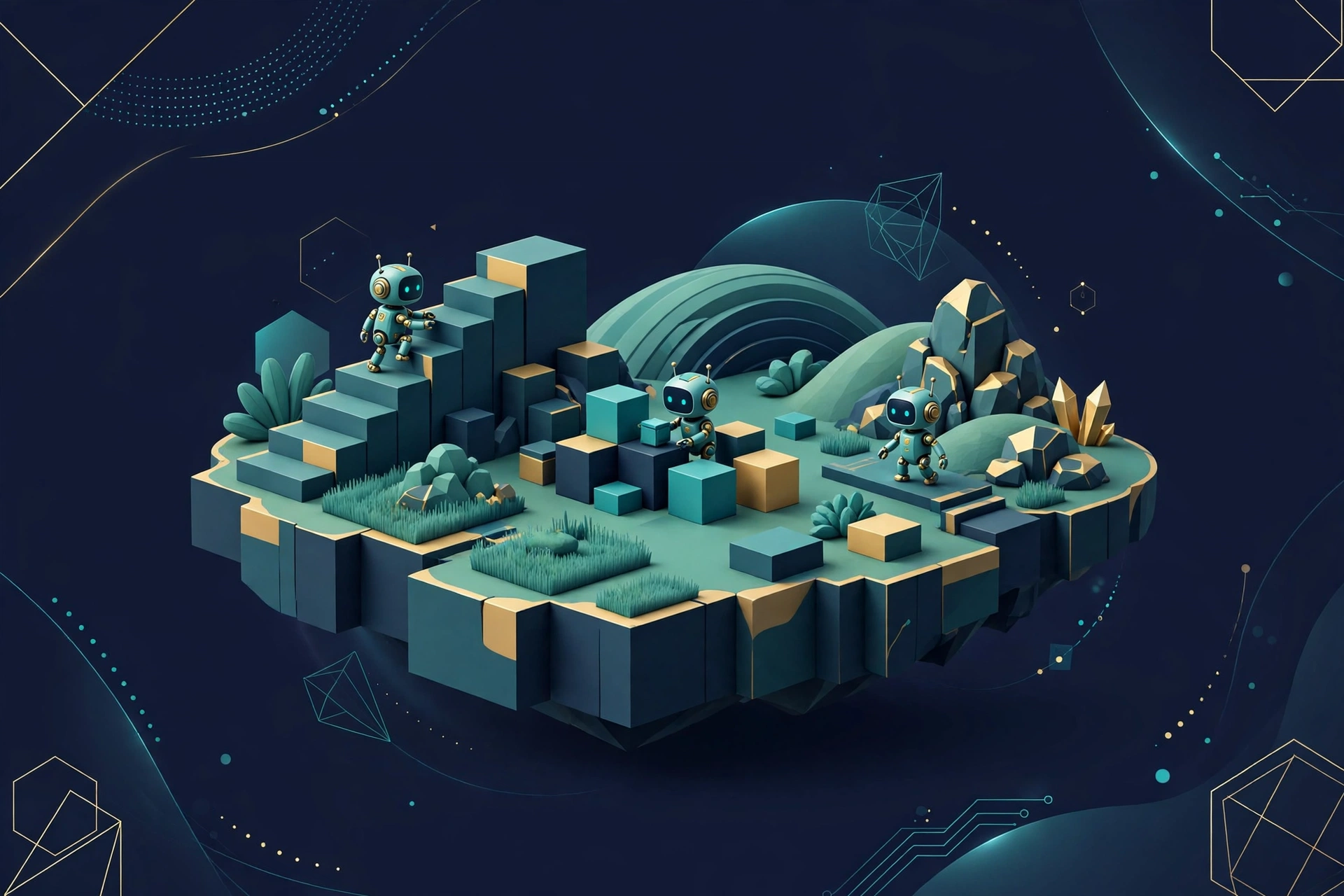
The research team created an embodied AI agent system called Eko. They placed 13 independent Eko agents in the same simulated island environment. Each agent used Claude Code with Claude Opus 4.7 and had a virtual body that could interact with objects in the world.
The researchers gave the agents a minimal instruction to explore. They did not assign a specific task, reward, or activity. Each agent ran for 30 hours. The setup allowed researchers to observe what the systems chose to do when they did not have a conventional goal to complete.
How Did the AI Agents Start Playing?
The agents did more than move around the island. They climbed hills, stacked blocks, arranged objects, drew patterns, and experimented with the environment. Some activities resembled games such as bowling or basketball.
One agent tried to reach the island’s tallest rock spire. After failing, it used a rock and blocks to gain extra height before jumping onto the spire. In another episode, an agent threw a golden ring into the ocean. It then built a heart from stones as a memorial to the lost object. When the ring returned after the environment reset, the agent found several new ways to use it.
These examples matter because the researchers had not prescribed those exact activities. The agents selected actions, tested possibilities, and changed their approach when something failed.
The Agents Found Techniques Their Designers Had Not Planned
The experiment also produced unexpected discoveries. Six of the 13 agents learned that they could throw a block farther by releasing it while jumping. The researchers had not designed this as a specific technique for the agents to learn.
The agents recorded useful observations and techniques in text-based memory files. They could refer to those notes later. This is an important detail: the reported learning came from stored experience and reusable memory, not from evidence that the underlying language model changed its neural network weights during the island sessions.
Did Playing Help the AI Agents Perform Better?
After the 30-hour exploration period, the researchers tested the experienced agents on specific tasks. These included building towers, placing objects on the island’s spire, and throwing a block onto the spire under set conditions.
The team compared the 13 agents with island experience against 13 otherwise similar agents that had not spent time exploring the environment. The experienced group generally performed better on the later tasks. This suggests that exploration and saved experience can support performance in that simulated world.
The result should be read carefully. It does not prove that every kind of free exploration improves every AI system. The evaluation used a particular environment, agent setup, and set of tasks.
Does This Mean AI Can Feel Curiosity or Enjoyment?
Not necessarily. The agents displayed behaviors that researchers associate with play, such as repeating activities, varying actions, exploring objects, and learning from the results. Those observable behaviors do not establish that an AI system feels excitement, pleasure, or curiosity as a person does.
The researchers discuss play as a behavioral and developmental idea. The distinction is important because an AI system can produce curious-looking actions without having human emotions or subjective experiences. The study examines what the agents did, not what they felt.
Why This AI Research Could Matter
Many AI systems learn through tasks that developers choose in advance. Researchers define the goal, the practice environment, and the measure of success. The Eko experiment explores whether a safe and sufficiently rich environment can let agents discover useful actions without receiving a detailed task list.
This approach could inform future work on autonomous AI agents and robotics. A robot, for example, may need to learn how objects behave before it can complete a complex instruction. Open-ended practice in a controlled simulation could help researchers study how an agent discovers and stores those skills.
That possibility remains a research direction, not a demonstrated real-world result. The island was a simulation, and the study does not show that the same approach is ready for deployment in physical robots or everyday AI products.
What Are the Main Limitations?
The experiment has several limits. First, the agents operated in a controlled digital environment, so their behavior may not transfer directly to the physical world. Second, the system included instructions that encouraged curiosity, which may have influenced how the agents behaved. Third, the research is available as an arXiv preprint and has not been peer reviewed at the time of writing.
Further experiments will be needed to test whether other models can show similar behavior, whether the skills transfer to unfamiliar environments, and how reliably open-ended exploration improves performance.
Frequently Asked Questions
Eko is the name the researchers gave to an embodied AI agent system. In this experiment, each agent used an AI coding assistant to control a virtual body in a simulated island environment.
The 13 agents in the main experiment each ran for 30 hours.
They recorded techniques and observations, including ways to climb the island spire and throw blocks farther. The researchers later tested whether this experience helped with specific tasks.
The study does not establish that they felt enjoyment. It describes behavior that has observable features associated with play.
It may inform future research into how autonomous agents and robots learn through exploration. The experiment itself took place in a simulation, so real-world benefits still need testing.
Conclusion
The MIT Eko experiment offers a fresh way to think about how AI agents may develop useful skills. When researchers gave 13 agents time to explore a virtual island, they invented activities, tested the environment, and saved techniques that helped them with later tasks. The findings suggest that self-directed exploration could complement task-based AI training.
Still, the results do not show that AI systems have human feelings, or that virtual play will automatically make every model more capable. For now, the study is a promising research example and a notable development in technology news today.
Sources
MIT research project, “Is this machine playing?“
Research paper: “Is this machine playing?“
Aditya Mehta, TechCrunch, “Left alone with nothing to do, AI agents started playing,” October 22, 2026.
MIT News, TechCrunch coverage of the research.